Nicaragua and international solidarity
In memory of Chuck Kaufman and Kevin Zeese
Revolutionary struggles around the world have always inspired admiration and support among the popular movements of the Western capitalist countries. Authentic Western progressive opinion defends the ideals of equality among people, brotherhood among nations, non-aggression and self-determination of peoples. However. from the perspective of the anti-democratic Western ruling elites, revolutionary processes present a double threat. First of all, they challenge the powerful political and economic dominance over the majority world of Western corporate and financial élites. Secondly, successful revolutions offer models of a more just society that responds to the aspirations and needs of the majority and not to the petty interests of a small, greedy elite.
In the case of the United States, the triumph of the Sandinista Popular Revolution in 1979 divided public opinion in the country that was paying attention to the outcome of the insurrection in Nicaragua. While the most reactionary sectors supported the barbarism of the Somoza dictatorship, the consensus among the liberal and progressive sectors supported its overthrow. The arrival to the US presidency in January 1981 of the anti-Communist fanatic Ronald Reagan signaled new reactionary policies increasingly aggressive towards the revolutionary movements of Latin America. For Central America, the result was an intensification of the North American military intervention in the region, which in Nicaragua took the form of a cruel terrorist war against the country’s people, accompanied by a sadistic economic blockade.
In North American and European public life in that period, political and media space, in the limited forms possible within the Western oligarchies of the time, was much larger than now. During the decade of the 1980s, the international solidarity movement with Nicaragua and its Sandinista Popular Revolution could influence to some extent political processes and the formation of public opinion in a way that for more than thirty years has become progressively less feasible. And it was at that time of the war in Nicaragua that solidarity flourished among much of the progressive sector of North American and European society.
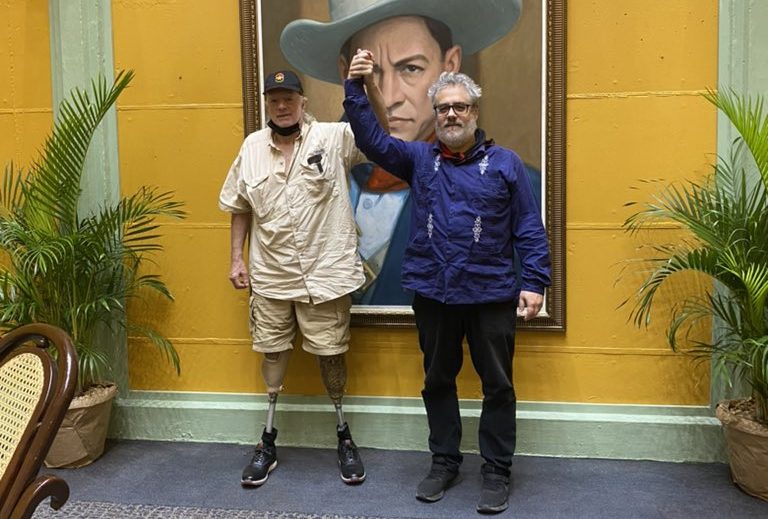
Brian Willson is the unparalleled example of the love for Nicaragua and its Revolution deployed by international solidarity. This year at the National Assembly, Brian explained how his experiences in Vietnam and Nicaragua helped him lose the fear of being afraid and commented, “It’s not heroic. It’s following the empathy of your heart. So to me the people of Nicaragua are heroic as are the people of Vietnam. It inspired me to join them in the struggle against Western imperialism led by the United States.” Brian’s feeling is common to many international solidarity activists who knew Nicaragua during the terrorist war imposed by President Reagan and have managed to transmit that love of Nicaragua to new generations of young people in their respective countries.
Political inspiration
Renowned lawyer and peace activist, Dan Kovalik who came to Nicaragua at the age of 19 in 1987, has written, “To witness the courage and perseverance of the Nicaraguan people in the face of the US’s unrelenting war of terror against them inspires me even to this day.” Dr. Arnold Matlin, tireless in his support of Nicaragua for over 40 years, recalls that, “My first trip to Nicaragua was in January 1988, during the Contra War. I found Nicaragua to be a country fighting to maintain its independence against an army of U.S.-supported mercenaries. I decided right then that Nicaragua was a country that I wanted to call my second country.”
Jeffrey Higgins followed the development of the Sandinista revolutionary struggle and the terrorist war against the Nicaraguan people from a very young age and comments, “the Sandinista example had imprinted itself on me and I thought I should do more. In my case, the moment arrived in 1987 when I became an internationalist collaborator in El Salvador with the FMLN. So, like the example set by Cuba has been an inspiration to many to step up and be counted, it was and is the Sandinista revolution that inspires me.” For almost all international solidarity activists, the example of commitment to the human development of Nicaraguan families is inextricable from the emphatic example of the defense of Nicaragua’s sovereign national dignity.
Barbara Larcom relates her visit to Nicaragua in 1989, when she visited San Juan de Limay and stayed at the house of a family recently displaced from their region by a terrorist attack. “The mood I sensed from nearly everyone then was hope and determination — that together they were laboring to create a country where people cared for each other and worked to meet everyone’s needs. On July 19 in Managua, we attended the tenth anniversary celebration of the Triumph, featuring human pyramids and dancing to loud revolutionary music and a stirring address from President Ortega. The energy and enthusiasm were contagious, and I succumbed to an eternal love for the country and its people.”
In the same way, Susan Lagos recalls “…when I came to Nicaragua in 1987 with Maestros por la Paz, I fell in love with Nicaraguans and their spirit of Revolution, fierce in their defense against the US empire, which has tried to control Nicaragua and its resources, while depriving the majority of Nicaraguans of their basic rights of education, housing, health care, and decent wages for their labor. ”
Kathy Hoyt lived in Matagalpa before the 1979 Triumph. She worked as a social worker caring for many malnourished children. She recalls that, at that time, more than 60% of children in Nicaragua suffered from malnutrition. Kathy comments “After the revolution triumphed in 1979, I worked as the health and social worker at the local Centro de Desarrollo Infantil Frank Sevilla. There I weighed and measured the children each month and watched them recover from malnutrition. In those first years of the revolution, childhood malnutrition was virtually eliminated, quoting my pediatrician husband. Everyone who wanted to study, children and adults both, was studying.”
Nan McCurdy, who came to Nicaragua in 1985 and lived in San Juan de Limay for more than three years, says “I support the Government of Reconciliation and National Unity because it is an example for the world of what it means to be a sovereign nation, an anti-imperialist nation. Seeing this example is especially crucial for small countries that are still under the boot of the United States.”
Irish university educator Aaron Kelly writes, “I have always been inspired by the Sandinista Revolution because of its core principles and ethics, and its people as the essence of those values, and its revolutionary actions and achievements that are the political expression of those values, values which have been heroically upheld in spite of the horrific violence inflicted upon the Nicaraguan people by imperialism and its proxies and lackeys. The Nicaraguan people have been collectively punished because they have valiantly fought against colonialism and imperialism and are building a society that offers an alternative to neoliberalism. A people so dignified and heroic as the Sandinistas deserve total respect and solidarity… The anti-imperialist struggle is the most just cause, the most urgent and necessary cause today, and I am glad that we can remember Sandino, that the struggle continues and that Nicaragua is on the front line of that struggle.”
Internationally famous for his interpretations of the martyred Chilean singer, Victor Jara, British songwriter Paul Baker notes his motivations for supporting the Sandinista Revolution in this way, “Repentant product/beneficiary of White Man Empire, I came in 1985 to support the Nicaraguan people’s gallant struggle – led by the Frente – against all facets and ongoing consequences of that criminal enterprise, social, political, financial, ecological. I stay for all the same the same reasons; but particularly to try to serve as cross-border bridge to promote the Frente’s stellar work re energy from renewables, indigenous lands, food sovereignty, coops, gender balance and the rest. All this was of course embodied in la Comuna and Sandino’s embryonic cooperative movement. For me, this is his most profound revolutionary work, too often overlooked despite its obvious increasing relevance for people throughout the world, as humanity begins to seriously fry, and the sixth great extinction devastates…”
British educator Alice Curteis came to know Nicaragua in the years of the neoliberal governments. “I first visited Nicaragua towards the end of the period of neoliberal government when Enrique Bolaños was president. The rural community I came to know well over the next 15 years is a couple of miles outside Esteli. In those days there were children who couldn’t attend school because their families couldn’t afford shoes, uniform, school supplies or backpacks. Medical appointments were free but medication was not. People could sometimes not afford even a single painkiller. There was little employment other than casual construction work. There was no running water and no electricity. Houses were almost all simple wooden structures with mud floors – and zinc roofs if the family could afford them. By the time of my last visit in early 2018 I could see the improvement in people’s lives with my own eyes – running water and electricity, all children in education with a free meal provided daily, university also free, free medical treatment, some young adults now able to fulfil their potential by progressing into jobs such as vets, pharmacists and lawyers. I know from friends and family there that since things got back on track after the coup attempt in 2018 improvements continue apace. For example, proper housing is now the norm and high unemployment is a thing of the past.”
Overcoming endless psychological warfare
During the 17 years of neoliberal misgovernment from 1990 to 2007, international solidarity with Nicaragua maintained valuable levels of moral support and practical solidarity to combat the constant US and allied country psychological warfare and keep alive the relations of brother and sisterhood between peoples. Many North American compañeras and compañeros fought with moral steadfastness, political astuteness and sensible prudence in the face of the constant divisionism promoted by disloyal ex-Sandinistas who exercised significant malign influence on foreign opinion. The events of 2018 demonstrated the genuine solidarity of hundreds of international activists with authentic revolutionary principles and a true love for Nicaragua and the Sandinista Revolution.
As Stansfield Smith remarked, “I knew enough to know if the corporate media starts attacking a government or a country, this is a prelude to “regime change”, and the US only wants to “regime change” countries that are carrying out progressive programs, defend their national sovereignty and are not under the US empire’s thumb.” Solidarity activists clearly see the undeniable reality of the successful transformation of Nicaragua by the Sandinista Popular Revolution led by Comandante Daniel and Compañera Rosario.
Jill Clark-Gollub notes that “Nicaragua is an example of dignity and humanism in a world that lacks human values; it is an oasis of peace and prosperity in a tumultuous world. It is a place where women, young people, peasants, workers and people of African descent and indigenous people are conquering more rights every day. However, Nicaragua does not only look inward, but raises its voice on the world stage to defend what is right.”
Noted writer and peace activist Roger Harris has observed “It is a beautiful sight to see Sandinista youth connecting to a revolution that was considerably older than them by celebrating the revolution songs. It is hard not to fall in love with the land of lakes and volcanoes. For us internationals, Nicaragua is an inspiration and a vision of what a good society can be.”
British writer John Perry remarks, “I have been a supporter of the Sandinista revolution since I first came to Nicaragua in 1984, but since living here from 2003 onwards I have seen the revolution’s real benefits. Of course, at that time the country still had a neoliberal government, and the neglect was apparent everywhere…Following the Sandinista return to power in 2007, improvements began almost immediately (for example, power cuts quickly came to an end). In the rural community where we live, which had had no electricity for a year, the supply was restored with government help, poverty started to be tackled through government programs, the school was improved and, later on, the dirt road to Masaya was paved and the water supply replaced. The nearest health center was modernised and is now open 24 hours daily, and the community also receives visits from mobile health clinics. The gang violence which plagues our neighbors in Central America has never been allowed in Nicaragua, which is why it is the region’s safest place to live or visit. Of course this is a reflection of the impact of the revolutionary government which has been felt across the country, but when you see it yourself, in your own community, it becomes an achievement which – at all costs – must be defended.”
Susan Lagos, who lives in Ciudad Darío, affirms “I personally have seen the ruins from the 1972 earthquake in Managua transformed into a beautiful modern city with parks, stadiums, and modern highways. The rural population no longer has to travel to Managua for free higher education and free excellent health care since there are multiple universities and hospitals in every department. … Anyone in their right mind would prefer to live here in peace rather than in the US where public services are in shambles, health care and education costs are exorbitant, and people live in fear under a government constantly at war and with a debt in trillions of dollars!”
Well-known writer and peace activist Gloria Guillo shares Susan’s criteria. Gloria comments “If more people understood Nicaragua’s success, they would expect more from our own leadership. Our leaders aren’t afraid of what Nicaragua does or can do, they are afraid of us realizing what Washington neglects to do for us at home by comparison. Our leaders are concerned that we may learn to stand up to the Epstein classes’ illegal and immoral activities at home and abroad. So, they target Nicaragua to eliminate the truth from being told. This keeps our people in the dark and not empowered.”
Similarly, Michael Boudreau, who lives in Carazo, declares “It would be difficult to find another government that has done as much for its people as the Sandinista government of Nicaragua has done. I can think of nothing more important than to promote, support and defend the Sandinista Revolution and the current Sandinista government, because it represents the best of us and, moreover, a true resistance to US imperialism.”
Many of the compañeras and compañeros of international solidarity accompanied the 2021 national elections. Rick Sterling of Task Force on the Americas recalls “In 2021, I was invited to observe and “accompany” the Nicaraguan national election. It was impressive to observe the protocols, procedures and dignity of the huge numbers of Nicaragua citizens proudly voting. This was during the covid crisis and everyone was wearing a mask, calmly proceeding in a very clear and transparent process. The ballot, election monitors, male and female co-directors of the election places all were tranquil and clear. At each polling place there were different party representatives. In short, I observed a clear and clean election… Unfortunately, US media distorts and lies about every country the US cannot control. It has been a pleasure to write some articles countering the widespread misinformation. Recently I have seen a different side of Nicaragua. In March this year, my family vacationed at Playa Majagual on the beautiful Pacific coast. We also spent several nights at Ometepe Island. Both venues were spectacular. My son, his wife and two children had a wonderful vacation… Nicaragua is beautiful, welcoming and relatively safe. ”
In a related vein, broadcaster Craig “Pasta” Jardula enthuses about Nicaraguan food. “…as an Italian-American, I can honestly say one of the best Italian restaurants I’ve ever been to was in Managua, Nicaragua. What impressed me most was that they weren’t outsourcing everything. Much of the food was locally grown. I had carpaccio made from Nicaraguan beef, incredible chicken and pasta dishes, and desserts that were absolutely top tier. A+ across the board. But that wasn’t the end of it. When I went to San Juan del Sur, I experienced all different types of food done at a high level — from shawarma spots that gave you a real taste of the Mediterranean, to pizzerias straight from the heart of Italy, to traditional Nica breakfasts with homegrown cheese, fresh eggs, beautiful rice and beans, and incredible local flavor. I know a lot of people go to Nicaragua for the surfing, the beaches, and the scenery. But we need to start talking more about the food, because it deserves recognition.”
Continued commitment
Barbara Larcom shares the feelings of admiration and affection for Nicaragua and its revolution “ I have continued to be inspired by the Sandinistas’ hope and determination, fostering participation by everyone to build a country in which people can thrive and develop as human beings. Nicaragua is amazing! I live in the United States, where we long for this same progress – the flourishing of universal healthcare and education and unity among people, accompanied by a resolute plan now in progress for abolition of poverty. It’s a beautiful example for us all.”
Becca Renk lives in Ciudad Sandino where she has promoted community development activities for more than 25 years. He says “I don’t know that I can put into words the relief, hope, and pride that one feels simply from living in a society where the government has the political will to look after its people and fight poverty. Just being here in Nicaragua is a huge paradigm shift for me from my upbringing in the empire, and even a quarter of a century later, I feel I have so much to learn. Far from sacrificing, I feel that it is an honor to be accepted here in this country and I will never take that for granted.”
Another outstanding writer and tireless activist with Black Alliance for Peace, Margaret Kimberley, has written that “…seeing for myself that a socialist state could exist in this hemisphere where nearly every nation bends to US will was a breath of fresh air. Visiting Nicaragua reinvigorated my determination to fight against the dictates of capitalism and imperialism. What we are told cannot exist actually does exist in Nicaragua.”
Veteran writer and peace activist Fred Morris records how he moved to Nicaragua with his family in 2007 and how “…we have rejoiced at how the Sandinista government has dedicated incredible effort to meet the needs of the poor majority. From the first education is free. They have built more than 40 hospitals!… They nationalized healthcare; built moved than 100 maternity hospices. Women have more rights in Nicaragua today than all but four Scandinavian countries. Half of the National budget goes to health and education. On 2021 I proudly became a citizen of Nicaragua.”
Nick Hoskyns from London has stayed in Nicaragua after first visiting in 1988, “Nicaragua has proved that through its good example it can prosper and contribute positively to the world. For the enemies of the revolution my humble opinion is that they were correct to perceive the “Danger Of A Good Example”. I would prefer to describe it as the hope and desire of a successful sovereign nation committed to its people, eliminating poverty and unleashing their potential. I feel so humbly fortunate to have come to Nicaragua at such a young age and worked with committed freinds & colleagues “Compañeros”. Inspired by the Nicaraguan cooperatives, Etico, the company we founded together has now evolved into and International Multi-stakeholder Cooperative. Once again we are innovating together and dreaming of a better way of doing things. The Nicaraguan way is contagious and I am hooked. That is why the imperial enemies of Nicaragua will not leave us alone, their aggression is just a measure of Nicaragua’s success. Hopefully I have picked up the positive attitude, the belief that things can be changed for the better in an equitable way, I most certainly have fallen in love with Nicaragua, its people, the cooperatives, the lakes and volcanoes and the ‘Revolution Popular Sandinista’ ”
US agronomist Nils McCune feels similarly, “I love Nicaragua because it is a constant reminder of what humanity can be. Like much of Central America, Nicaragua is full of loving, caring, hardworking and respectful people. But unlike the rest of the Isthmus, Nicaraguans have a genuinely unique historical experience—that of defeating their historic oppressors and practicing people’s power. Not only this, but the Nicaraguans have done it again—first from the popular insurrection until 1990, and now again from 2007 to the present. And of course, this goes much further back than 1979—it is part of the indomitable character of the Nicaraguan people since Benjamin Zeledon and Augusto C. Sandino first stood up to US imperialism. This lived experience of the victory of the Common Good shows up over and over again in the way that Nicaraguan people confront challenges, from daily efforts to maintain clean and healthy neighborhoods, schools, clinics and streets, to the way the country manages its economy and ecosystems. Belief in the Common Good—and in one another—informs a kind of revolutionary ethic that permeates Nicaraguan society and is part of the message that people give to and receive from their Government of National Unity and Reconciliation. Nicaraguans believe in themselves and have shown time and again their capacity to overcome adversity.”
British trades Union leader Kevan Nelson recalls his experience of the July 19th anniversary in 2024, “As a long-term supporter of FSLN and the Nicaraguan people, I was delighted to have the opportunity to visit Managua for Revolution Day celebrations in July 2024. I attended as the international secretary of the Communist Party of Britain. It was the 45th anniversary of the 1979 Sandinista Revolution. The 5-hour long event, attended by 600 international solidarity guests who were welcomed into the main square, was a combination of Nicaraguan culture and powerful anti-imperialist and internationalist politics. A special guest was veteran Palestinian revolutionary Leila Khalid… A key refrain was the Sandinista doctrine of Socialism, Christianity and Solidarity. The atmosphere at the rally was electric and characterised by revolutionary music, chanting and a sea of red/black FSLN and national flags in the vast 100,000 crowd representing all sections of Nicaraguan society and state but with a strong core of FSLN youth – confident, patriotic, proud and resilient in the building of an alternative political system to exploitative capitalism. It was memorable to witness a Revolution reborn.”
Many of the internationalists who have decided to make their lives in Nicaragua have received the privilege of Nicaraguan citizenship. Nan McCurdy comments, “I have the honor of being a Nicaraguan citizen, thanks to Co-President Rosario Murillo. And I now have a 7 month old granddaughter who is Nicaraguan… One of the most important reasons I support the Government of Reconciliation and National Unity is because it is an example to the world of what it means to be a sovereign nation, an anti-imperialist nation. Seeing this example is especially crucial for small countries still under the boot of the United States.”
Political activist Sarah Flounders also appreciates the great example of the Sandinista government in Nicaragua, “As part of the SanctionsKill Campaign I was acutely aware of the amazing accomplishments of Nicaragua, while under continuing U.S. sanctions, that are intended to frustrate Nicaragua’s development and modernization… Development is not a passive process. Nicaragua seems to have hundreds of grassroots level initiatives. My favorite question everywhere I traveled in Nicaragua was to ask: “what’s new?”. No matter who I asked, out would spill a stream of changes and concrete improvements from improved bus service to rodent illumination or new markets. No one ever just shrugged and looked down. That is national pride and collective pride. The Sandinista / FSLN government is moving forward with great determination. A visit to Nicaragua gives new energy to everyone who is fighting and organizing for change.”
Nicaragua generously and humbly welcomes all the gestures of international solidarity, exemplified by the heroic dedication of Brian Willson, celebrated recently in the National Assembly in an Act that expressed the authentic dignity of the Nicaraguan spirit. In the same way, Co-President Comandante Daniel commented in 2021, “There are many North Americans who are Friends of the Peoples, who write to us, who give us Solidarity, and to those North American Brothers and Sisters we say: Thank you, you honor the North American People…” And Co-President Compañera Rosario highlights the essential contribution of solidarity when she salutes “our Compañeras, Compañeros, Brothers and Sisters of the Beautiful, Intense, Solidarity, that Great Fraternity that fights on and wins through, as we have fought and as we are winning, creating Together a New, Better World of Joy, Justice, Work, Friendship. A World of Peace, Peace, Peace…!”
Published by Tortilla con Sal. The photograph shows Brian Willson and Dan Kovalik, standing in front of a portrait of Augusto César Sandino.