“InSight Crime” Defends an Indicted Criminal: Crime Doesn’t Pay, But US Government Grants Do
InSight Crime, a thinktank which claims to fuse “investigative journalism with academic rigor,” accuses Nicaragua’s government of “hiring assassins” to hunt down and kill opponents abroad. This bold accusation is based on no more than “circumstantial” evidence, strongly suggesting political motivation. This fact-impoverished rush to judgment reflects a more general bias of the US-aligned corporate press, which seeks to demonize Nicaragua and its Sandinista political leadership.
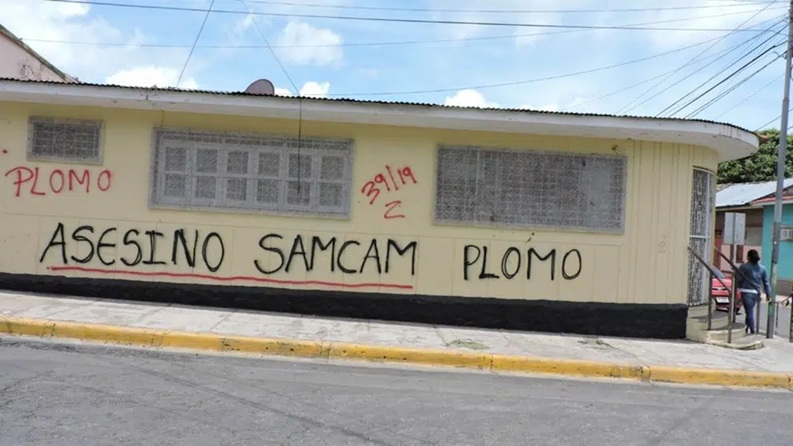
The focus of the thinktank’s article is the death of Roberto Samcam, a former Nicaraguan army officer, exiled in Costa Rica. He was assassinated by gunmen in his home in a gated community in the capital, San Jose, on June 19, 2025. InSight Crime says he was killed because he was “fomenting regime change” in Nicaragua. Supposedly linked to this crime are two failed attempts to murder a Nicaraguan associate, Joao Maldonado, also exiled in Costa Rica and – like Samcam – an opponent of Nicaragua’s Sandinista government.
So far, almost a year after Samcam’s murder, the authorities have made four arrests in the case. All the arrested are Costa Ricans and none have been brought to trial. Keny Navarrete, a Nicaraguan criminal incarcerated in Costa Rica, is said to have coordinated the assassination. Navarette, who has no known connection to Nicaragua’s government, has been serving multiple sentences in Costa Rican prisons since 2016: supposedly he was able to orchestrate the crime from his prison cell.
Samcam’s criminal record
InSight Crime notes in passing that both Samcam and Maldonado were “charged with crimes” in Nicaragua, but nevertheless the author, Steven Dudley, asserts that “Samcam was not a criminal.” Curiously for a prize-winning crime investigator, Dudley completely ignores the real violent crimes carried out by Samcam, Maldonado and the groups they led in the Carazo region of Nicaragua in 2018, during a coup attempt against its Sandinista government. An email to InSight Crime asking why he omitted Samcam’s backstory received no reply.
Roberto Samcam was discharged from the army for corruption. He became a member of the opposition MRS (Movimiento Renovador Sandinista), which in April 2018 organized anti-government protests that quickly became armed blockades of several cities and violent attacks on police, Sandinista sympathizers and ordinary Nicaraguans.
During a “national dialogue,” arranged by the Catholic church, the Nicaraguan government confined the police to their police stations as part of an agreement to restore peace. However, in Carazo and elsewhere, armed opposition mobs reneged on their side of the deal, laid siege to the police stations and created lawless chaos. Gang members from elsewhere in Central America were even brought into Nicaragua to foment violence.
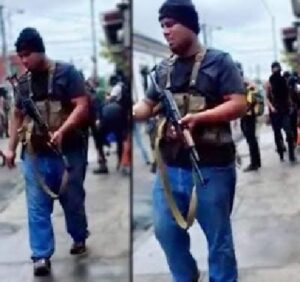
Samcam was one of the principal agents of the coup attempt in Carazo. He set up and led one of the two armed groups that controlled Carazo from May 17 until July 8; Maldonado and his father controlled the other group. Their headquarters was a Catholic college (Samcam’s wife reportedly bribed the nuns to vacate it). The college quickly became notorious as a prison and torture center where kidnapped Sandinistas and government officials were held.
One of the perpetrators present at the college later confessed his involvement, saying that the opposition leaders “lied to us and manipulated us.” Ferson Castillo, gave a moving account of the murder of his father and brother by opposition groups. Castillo himself was also kidnapped, taken to the Catholic college and tortured. The state of other victims released from the college can be seen in another video.
Another witness recounted how Samcam and other opposition leaders manipulated a visit by representatives of the Inter-American Commission on Human Rights, blaming murders of known Sandinista sympathizers on government forces. Samcam was later identified, along with Maldonado, as leaders of the group which carried out one of the most horrific crimes of 2018 – the prolonged torture and murder of municipal worker Bismarck Martínez. Samcam reportedly supplied the PKM machine gun used to kill police officers before they eventually liberated Carazo on July 8.
Nicaragua’s foreign minister, Denis Moncada, addressed the assembly of the Organization of American States on July 11, 2018. He presented a detailed report on the violence in Carazo, using it as an example of how Nicaragua had suffered during the coup attempt which was then coming to an end. The report listed eight violent deaths, including two police officers, multiple incidents of kidnapping, rape and torture, an attempt to explode empty fuel tanks positioned next to the police station (which was under siege), and holding hostage around 400 international freight drivers whose trucks were blockaded on the Panamerican highway for many weeks.
The context of the murder
Samcam, apparently anticipating legal retribution, fled to Costa Rica three days after Carazo was liberated, never to return to Nicaragua. He was indicted in absentia in a Nicaraguan court in August 2018, along with other ex-military personnel, for the armed attack on the police headquarters in Jinotepe that lasted for 25 days.
InSight Crime also ignores the context for Samcam’s murder in San Jose. In 2025, Costa Rica experienced a massive number of homicides – as InSight Crime had pointed out elsewhere. The country became a “hub for the cocaine trade” run by transnational criminal groups.
Of the 500,000 Nicaraguans living in Costa Rica, only a small proportion are involved in such crime. However, Keny Navarrete, a suspect in the Samcam case, is one of the 10-13% of the prison population that is Nicaraguan. Highlighting the arbitrariness of inferring a political motivation for Samcam’s demise, during 2025 alone more than 90 Nicaraguans were murdered in Costa Rica.
Writing shortly after the murder, we noted that there were indications that – in exile – Samcam had become involved in criminal activities. In any case, his violent past and his reported drug addiction might have given Steven Dudley cause to investigate other possible motivations for his murder.
He who pays the piper calls the tune
Although InSight Crime concedes at the end of the article that its “assertions are difficult to substantiate,” the opening paragraph has already framed the narrative by asserting that Nicaragua’s government murders its political opponents.
This up-front assertion of the Nicaraguan government’s culpability prefaces a one-sided and biased investigation. A glaring factor which InSight Crime has in common with Roberto Samcam, his accomplices in Carazo, and other exiles and opposition media blaming the Nicaraguan government for his assassination, is that they have all received and, in some cases, continue to receive funding from US government-sponsored agencies.
Samcam was listed as receiving money from the National Endowment for Democracy (NED) in 2022. The current NED president, Damon Wilson, recently confirmed that they are funding multiple Nicaraguan opposition groups based in Costa Rica. Beforehand in Carazo, Samcam had worked with the Instituto de Estudios Estratégicos y Políticas Públicas (IEEPP), funded by both the NED and USAID.
InSight Crime is far from an impartial body. The organization and its host institution – the Center for Latin American and Latino Studies at American University – publicly disclose funding from the US State Department and USAID, along with moneys from the British, Swedish, and Canadian governments, in addition to the Open Society Foundations. These relationships are corroborated by official grant databases, tax filings, and funder disclosures.
The central issue is not merely that InSight Crime receives funding; nearly every nonprofit newsroom depends on external financial support. Rather, the concern is that its funding comes from governments and policy-oriented foundations whose strategic interests overlap with Washington’s regime-change agenda for Nicaragua. InSight Crime’s IRS Form 990 filings indicate that virtually all of its reported revenue derives from such sources.
A funding model centered on the US government and its Western allies, together with a major Western private foundation, is a clear indication of institutional bias. Our article doesn’t answer the question of who murdered Roberto Samcam, but it does address the imbalance created by InSight Crime’s distorted analysis.
Roger D. Harris is with the Task Force on the Americas and the Nicaragua Solidarity Coalition. Kelly Nelson is a journalist based in Nicaragua.
Published in Resumen Latinoamericano, Popular Resistance, LA Progressive, Counter Currents, Counterpunch, Antiwar.com, Sri Lanka Guardian, Tortilla con Sal and elsewhere.