The houses were made of cardboard
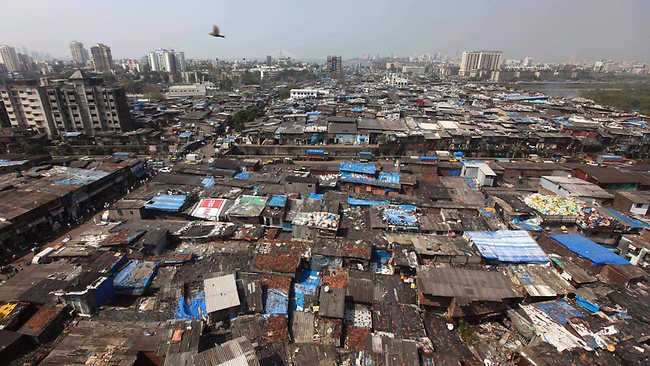
Worldwide, one billion people live in slums. By 2050, it might be two billion. India has the world’s second largest slum population, after China. In 2009, the government launched a plan for a ‘slum free India in five years’: since then, slum growth has continued unabated. Mumbai has more than nine million slum inhabitants, up from six million ten years ago. In the face of such statistics it is easy to be pessimistic. Yet most slums are hives of economic and political activity. Shack/Slum Dwellers International and its president, Jockin Arputham, have been nominated by the Swedish housing minister for this year’s Nobel Peace Prize.
The movement began in Mumbai fifty years ago. Jockin went to live in the slum district of Janata, where ‘the houses were made of cardboard’, in 1963, at the age of 17. He had a paid job as a carpenter but in his spare time set up a school. His first peaceful protest against slum conditions was to organise the children to march to the town hall with parcels of stinking rubbish which they deposited on the steps, to demand a proper refuse collection service. Jockin soon became the main ‘agitator’ (his word) in fighting proposals that would have led to 70,000 people in Janata losing their homes.
After 29 days squatting outside the parliament in New Delhi, Jockin secured an interview with Indira Gandhi. She reluctantly agreed that the demolition wouldn’t take place until residents had been properly consulted. Jockin insisted on having the decision in writing. But the letter was a ruse, and officials tipped him off that he’d be arrested when his train arrived in Mumbai. On the city outskirts he pulled the communication cord, escaped and spent nights sleeping in a drainage pipe. By day he was accompanied everywhere by crowds of women from the community. But he was eventually arrested and jailed more than sixty times for organising protests, before being forced into exile.
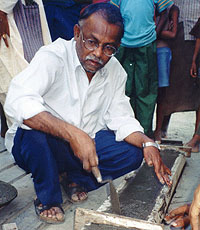
He returned to India when Gandhi lost power in 1977. He toured the country to set up the National Slum Dwellers Federation (NSDF). With the Mumbai NGO SPARC they carried out pioneering censuses of slum settlements. With a women’s organisation, Mahila Milan, they set up communal savings schemes through which thousands of slum dwellers are able to accumulate enough money to improve their homes or invest in small businesses.
I met Jockin in 1991 on behalf of Homeless International. He wanted me to meet the state housing minister to hear about his attitudes towards slum dwellers. We went for dinner. Jockin hardly spoke as the minister explained how the slum problems were being solved. The next day, Jockin took me on a whirlwind tour by train and auto rickshaw. In Goregaon I met Sita Shivaji, who’d been forced out of a slum settlement by the authorities and dumped 15 miles outside the city. She was working with 51 other families in a self-build project financed through a savings scheme. Ten miles away in Jankalyan, I met Yasoda Vilas, who’d also been in a displaced community, this one living in shacks alongside a railway line. Community pressure secured them a building plot where 115 families were just about to start work. Fifty other railway dwellers’ groups were working with NSDF and SPARC on similar self-build projects.
In the centre of Mumbai, Dharavi is thought to be Asia’s biggest slum, housing perhaps a million people within one square mile. There I met a Muslim woman, Farida, whose family with 325 others had also faced eviction, this time by the army. She was one of ten activists arrested for refusing to move. They were eventually allocated land in Dharavi only to find their ‘plot’ was a stinking pond. They spent months filling it and then building very basic new houses.
In 1996, Jockin started Shack/Slum Dwellers International, which has grown to cover 33 countries across three continents. It’s probably the world’s biggest and most effective network for south-south exchange among poor people, inspired by the co-operative models and peaceful forms of protest that Jockin pioneered in Mumbai.
In Brazil its affiliate Interação is also promoting savings schemes. Dilma Rousseff’s government, determined to tidy up the favelas before the World Cup, has resorted to force. But, as Jockin’s work has shown, repression and forced removals don’t work. Eventually, slum dwellers have to be engaged in finding ways to meet their needs in the places where they already live.
Original post and comments: London Review of Books