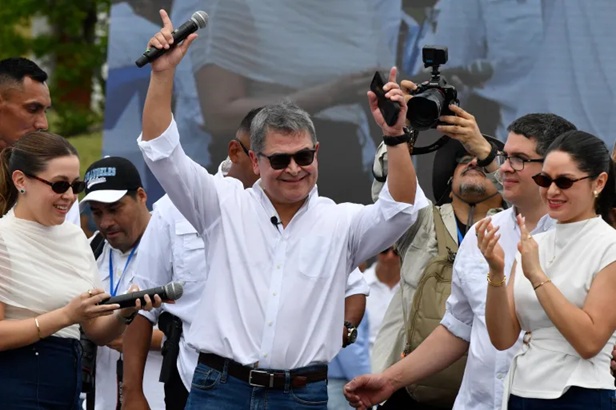
Hernández returns to Honduras
In mid-July, Donald Trump railed on primetime TV against alleged foreign interference in US presidential elections. While commentators were sceptical, they largely ignored the long history of US meddling in other countries’ elections. In Honduras, only six months earlier, Trump’s endorsed candidate won a slim majority in an election that he had turned into a regime-change operation.
Trump’s most shocking move to influence the electorate was to pardon the former Honduran president Juan Orlando Hernández, serving a 45-year prison sentence for trafficking cocaine to the US. JOH is the patriarch of the National Party, and his release helped lift its candidate, Nasry Asfura, from third in the polls, sealing the fate of the progressive Libre party which had ruled for four years.
It was unclear if JOH would return to Honduras, where he still faces criminal charges. But on 26 July he landed at Palmerola airport in a private jet, welcomed by the new president of the National Congress, Tomás Zambrano, and hundreds of supporters. It is Zambrano’s job, having appointed a compliant attorney general and head of the supreme court, to ensure that JOH emerges unscathed from any criminal proceedings, free to run for president again in 2029.
Trump’s resuscitation of a drug-trafficker’s political career fits a pattern. Daniel Noboa, re-elected president of Ecuador last year, has a family business that exports bananas to Europe. Large quantities of cocaine have been found in several shipments. Trump effectively endorsed Noboa by inviting him to Mar-a-Lago weeks before polling. In Colombia’s recent election, Trump openly supported the eventual winner, Abelardo de la Espriella, despite his career as a ‘maverick lawyer’ who defended cocaine traffickers.
Washington pays lip-service to the war on drugs, but its real war in Latin America is against progressive government or grassroots action for societal change. In July, Trump’s ‘under secretary of war’ told regional defence ministers of a new ‘military focus’ on dismantling narco-terrorist networks which he blamed on ‘hard-left regimes’. Then the US State Department published a bizarre hundred-page report accusing Cuba of promoting extremism and subversion in the US and across the region. Afterwards, Marco Rubio called a meeting of sixty governments, including Asfura’s, framing far-left terrorism as an emergency and calling on them to ‘crush this evil for ever’.
Before leaving the US, JOH may have been actively contributing to Trump’s plans. Leaked audio recordings appeared to show him orchestrating a US-supported disinformation campaign aimed at progressives across Latin America, including the left-wing candidate in Colombia’s election.
On the day of JOH’s return, new recordings revealed a plan to monitor social media in Honduras. The country has a long history of persecuting human rights defenders, epitomised by the murder of Berta Cáceres in 2016. On 21 May, in the Aguán Valley, the scene of multiple killings in the past, twenty peasant farmers were killed, apparently by gunmen acting for landowners. Within days of the massacre, Asfura’s government advanced new legislation strengthening the position of landowners and issued a decree allowing the prosecution of ‘terrorist associations’.
In July, in another land dispute, a Garifuna coastal community was invaded by more than two hundred police officers supporting the claims of a foreign investment company. Five community leaders were arrested; their cases have been sent to a higher court for investigation as ‘organised crime’.
Trump’s intervention in Honduras also ensured that progressive government was replaced with bipartidismo: a pretence of adversarial politics between two traditional parties (Nationals and Liberals, who now dominate the Honduran Congress) while both prioritise the interests of big business and landowners at the expense of the 63 per cent of the population living in poverty. Honduras is already the region’s most unequal country. Since taking office six months ago, Asfura has reduced the health budget, halted the construction of new hospitals and cut electricity subsidies that benefitted 600,000 poor families. Budget savings have enabled him to extend tax incentives for big businesses for a further five years. If JOH succeeds him as president, worse may follow.
Published by the London Review of Books.