Skip to content

Two Worlds

A blog about Latin America,
from a writer in Nicaragua

  • Home
  • Latin America
  • Nicaragua
  • Honduras
  • UK housing & migration
  • About
  • Contact

Two Worlds

A blog about Latin America,
from a writer in Nicaragua

Home / Nicaragua / By ox cart to Popoyuapa
Nicaragua

By ox cart to Popoyuapa

John Perry March 18, 2018July 18, 2025

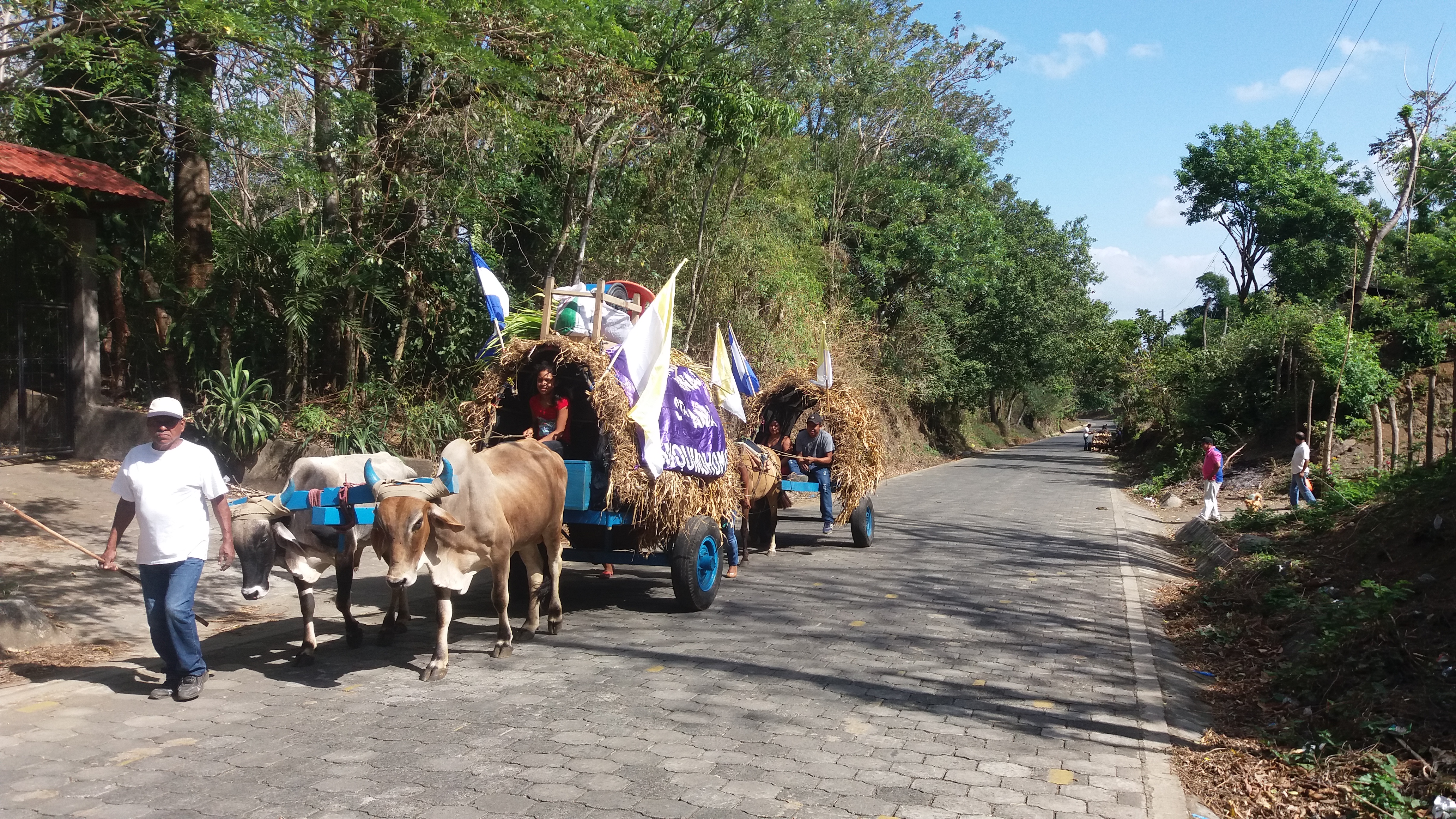
Dozens of highly decorated ox carts are slowly making their way south from Masaya and two other cities in the central part of Nicaragua’s Pacific coastal regions. They are heading for a small place called Popoyuapa, in Rivas, Nicaragua’s southern-most department, bordering the frontier with Costa Rica. Their route south is along the pan-American highway, where police will slow down the normal traffic to give the ox carts safe passage. The journey there, which in a car would take little more than an hour, will require four days of travelling at less than walking pace, followed by four days for the journey back.

The pilgrimage is an annual event that takes place two weeks before Easter. The aim is religious – to honour the image of Nuestro Señor del Rescate, to whom is attributed various miracles. The dominant colour of the ox carts is purple, for Easter, but blue (for Nicaragua, the colour of its flag) and yellow (for Catholicism) also abound. On each cart is built a shelter of palm leaves in which the family – and often its dogs – travel, carrying food and water for the trip.

The photo shows our neighbour, Don Lencho, who this year set off with two carts carrying most of his family and one of their dogs. He said they’d been sponsored by someone for the cost of the food they were taking, and they had a sponsor in Rivas who would lend them his field to allow the cattle to eat and rest before the return journey.

The tradition and the pilgrimage are over a hundred years old. A couple of decades ago the procession had dwindled to only a few diehard travellers, but then it enjoyed a revival and today it gets government support. When the caravan leaves each of the towns, people line the streets and it gets raucous accompaniment from ‘los chicheros’ (street bands).

Unlike many such traditional festivals, it doesn’t date back to the time of the conquest or earlier (many indigenous customs and dances were adopted and adapted by the early Catholic church, and survive as a mixture of the sacred and profane). No one seems to know why it is only people from Masaya, Granada and Carazo who make the trip south. What is now a slow but fairly comfortable journey on a paved highway would, until a few decades ago, have been an even slower, more difficult affair using rutted, dusty tracks.

Such questions don’t seem to bother Don Lencho and his fellow travellers, who rarely get the chance to travel outside the cities and the villages that they come from. All those involved give the impression that they are making the trip principally to have a good time (except, perhaps, for the oxen).

Post Tags: #Nicaragua#Spanish conquest

Post navigation

Previous Previous
The NICA Act – What is it and why should it be opposed?
NextContinue
Developers are skimping on low-cost housing: time to get tough

Subscribe to Our Newsletter

Subscribe to the Two Worlds blog and we'll send you an email alert when we publish a new post. Please review our Privacy Policy if you have any questions or concerns.

Check your inbox now to confirm your subscription.

Categories

  • Latin America
  • Nicaragua
  • Honduras
  • UK housing & migration
  • Masaya project updates
  • Energy and the environment
  • Central America wildlife
  • Book reviews
  • Obituaries

Tags

allocations ALMOs Argentina borrowing rules budget butterflies census climate change Colombia community cohesion Costa Rica council housing Cuba drugs energy efficiency environment Green Deal homelessness Honduras housing housing benefit housing finance housing investment housing policy investment Latin writers Malvinas Masaya media Mexico migration migration policy migration statistics model cities Nicaragua Paraguay pension funds private rented sector rents right to buy tenancy reform tenant involvement transport US intervention welfare reform

Blogroll

  • Articles for Antiwar.com
  • Articles for Black Agenda Report
  • Articles for Counterpunch
  • Articles for Covert Action Magazine
  • Articles for Global Research
  • Articles for LA Progressive
  • Articles for Monthly Review online
  • Articles for NACLA
  • Articles for The Grayzone
  • Articles for The Guardian
  • Articles in People's Dispatch
  • Blogs for Council on Hemispheric Affairs
  • Blogs for Open Democracy
  • Blogs for the London Review of Books
  • Posts for Fairness & Accuracy in Reporting
  • Posts in Sheerpost
  • Two Worlds on Substack

Related websites

  • Chartered Institute of Housing
  • Council on Hemispheric Affairs
  • Housing Rights
  • Nicaragua Solidarity Coalition
  • UK Housing Review
Housing Guardian contributor
John PerryJohn Perry lives in Masaya, Nicaragua where he writes about Latin America for the Grayzone, Covert Action, FAIR, London Review of Books, Morning Star and elsewhere, and also works on UK housing and migration issues.

Copyright © 2012-2025 Two Worlds | Privacy & Cookie Policy

  • Home
  • Latin America
  • Nicaragua
  • Honduras
  • UK housing & migration
  • About
  • Contact
Search