Housing in Europe: How does Ireland compare?
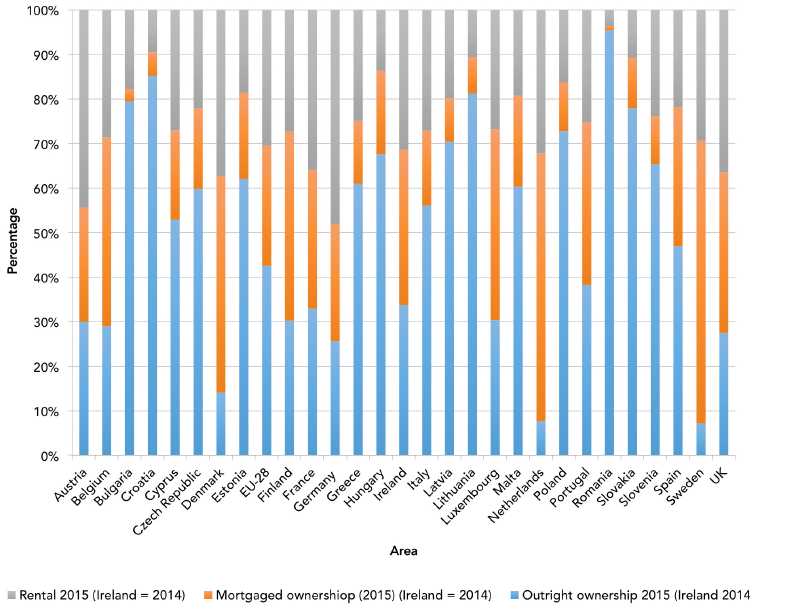
Europe has become a continent of owner-occupiers. That might be the conclusion from looking at the article in this year’s UK Housing Review on the state of housing in Europe. But the real picture is more complex, revealing some interesting comparisons between Ireland and its EU neighbours.
Whereas some time ago both Ireland and the UK stood out for their high levels of homeownership, Ireland now ranks seventh from bottom of Europe’s owner-occupation table, with the UK lower still (see chart). People in Sweden are now more likely to live in owner-occupied dwellings than those who live in Ireland. However, the range of owner-occupation levels in Europe is still very wide. The southern European countries had the highest ownership levels before the EU expanded from 2004, but it’s now the new members from central and Eastern Europe that lead the table. Whilst just 52 per cent of Germans and 56 per cent of Austrians live in owner–occupied housing, almost everyone (96 per cent) does so in Romania.
Ireland moves up the rankings where only outright owners are concerned (those who have paid off their mortgages). Ten states, including the UK, have lower levels of outright ownership than Ireland. Oddly, the countries with highest levels of outright ownership are several of those from the former socialist block, notably Romania, Croatia and Lithuania (all above 80 per cent). This is to do with both the patterns of ownership under communism, especially in rural areas, and the post-Communist privatisation programmes in which houses and flats were effectively given away.
Obviously, the converse of high proportions of homeownership is high proportions of renters, and Ireland ranks seventh in Europe (the UK is fourth). The official EU statistics don’t allow an easy split of social and private renting – partly because in some countries (notably Germany, where private landlords get subsidy to house social tenants) the categories overlap. While Ireland now has a relatively small social sector, in fact only six countries (including the UK) have a bigger one. Leading the field here are the Netherlands, Austria and Sweden. Denmark’s quasi-social housing associations, although not included in the rankings, are also significant, housing about one in five households.
The roles played by the social sector vary considerably. While in Ireland it caters mainly for those on low incomes, in parts of northern Europe it has a wider role and even (as in Sweden) may exclude the poorest households. But in southern, central and eastern Europe, ‘social’ housing tends to mean a very residualised sector for marginalised groups, quite separate (often physically as well as functionally) from the mainstream – a very basic ‘ambulance service’.
In terms of housing conditions, it is of course difficult to get consistent, Europe-wide statistics, but on two scores at least – overcrowding and what is called ‘severe housing deprivation’ Ireland does well. Overcrowding mostly affects Eastern European countries, although Austria has a notably high overcrowding level for one of the more prosperous EU states, and Greece and Italy have poor scores on housing deprivation.
The EU has a house-price index which only begins in 2010, and so of course it does not reflect the peak prices that occurred before the financial crisis in 2008. According to this, only in Spain did real house prices fall more quickly after 2010 than in Ireland, by almost 40 per cent. Ireland’s prices fell by one-third, although of course they have since recovered substantially. The Netherlands and the UK saw more modest falls but slower recoveries. Some countries like Germany, Austria and Sweden have seen steady price rises. In several eastern European countries prices remain below their 2010 levels.
Comparing housebuilding figures also runs into data problems. But in terms of building rates per 1,000 population, Ireland was – as would be expected – well above average in 2006 but then suffered a sharp decline from which it has recently begun to recover. Over the period 2006-15, the UK remained the poor man of Europe: it recorded the lowest average annual level of housebuilding among the countries for which statistics are collected.
Despite the message that owner-occupation is the Europe’s dominant tenure, the housing scene varies widely between countries, especially since the growth of the EU after 2004. Ireland remains distinct in many ways – a modestly sized homeownership market, which has seen extremes of volatility perhaps only equalled by those in Spain, and a still sizeable rental market in which social housing’s role diminished but is now recovering. Will housing in Ireland become more (or less?) like that in other Northern European countries over coming decades?
This article appeared in Housing Ireland Autumn 2017, and is based on a longer one by Mark Stephens in the UK Housing Review 2017. Take a look at the Review’s website (www.ukhousingreview.org.uk) to check out the full range of material it provides.