We can’t tackle child poverty without investment in affordable housing
It’s a formidable task: there’s cross-party commitment to radically reducing child poverty in the next five years. Indeed, the Chancellor said in the March budget that ‘child poverty is down’. But is that true and what is needed to ensure that the number of children in poverty not only stays down but falls to 10% by the government’s 2020 target date.
The problem in assessing George Osborne’s claim is threefold. One is that the latest poverty statistics are for the year ending in April 2013: the data for 2013/14 won’t be published until after the election. The second is that many of the changes in welfare benefits either didn’t start until April 2013 (e.g. the benefits cap and the bedroom tax) or their effects were still being phased in. It is only really with data for last year and the year just ending that we’ll be able to see if progress towards ending child poverty has been sustained.
But the third problem is the trickiest. By April 2013 around 300,000 fewer children were in poverty compared with April 2010, if assessed on the ‘relative poverty’ measure (incomes less than 60% of median incomes). But on the ‘absolute poverty’ measure favoured by David Cameron, child poverty actually increased by 200,000. The difference occurs because median incomes were still falling after the recession and so fewer people are ‘relatively’ poor as their incomes were propped up by state benefits. The Institute for Fiscal Studies has projected poverty rates for 2013/14 and 2014/15 and these show slight increases in child poverty on both measures.

What’s this got to do with housing? The figures just mentioned, whether relative or absolute, don’t take account of housing costs. And it turns out that housing costs have a huge influence on poverty levels. The first chart, taken from the UK Housing Review 2015, shows how poverty rates have been rising when housing costs are taken into account. Working-age households are worse off and those with children are most affected.
The coalition has a commission, led by Alan Milburn, to make recommendations on child poverty and social mobility. The commission said last year that ‘the effect of high housing costs on living standards must be addressed’ because over the period 2010-15 housing costs have pulled extra families with 1.4 million children into relative poverty. He warns of the danger of ignoring housing costs in the policy choices which the next government faces.
In the run up to the election, the commission has issued a new report calling on the next government to make tackling child poverty (and social mobility) part of the core business of the new parliament. It sets out five key priorities, of which one is ‘to restart the twin engines of social mobility: education and housing’. It calls on all parties to spell out how they will increase housing supply, widen opportunities for young people to become homeowners and deliver secure, fairly priced housing for those who can’t afford to buy.
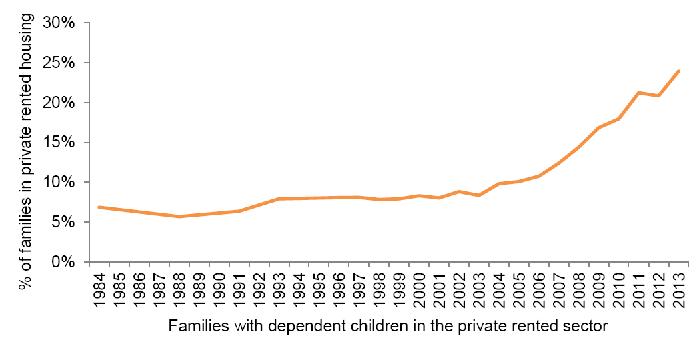
The second chart, from this latest Milburn report, shows that the proportion of families with children now living in the private rented sector has shot up in the past decade. Clearly, high and rising rent levels and the limited security associated with private tenancies need to be addressed, as does the urgent need to provide more social housing as an alternative for families with children.
The urgency of Milburn’s proposals becomes even more apparent when looking at the latest projections for child poverty from the IFS. As they say, even in April 2013 ‘relative’ child poverty was over 17% and starting to rise, as against the target of cutting it to 10%. Since then the government has criticised its own child poverty definitions but remains committed to the legal targets. The IFS points out though that there is no plan for how it will reach them and indeed the March Budget envisaged another £12bn of unspecified welfare cuts, which are bound to place them further in jeopardy. It might have added that remorselessly rising housing costs, identified as a key factor by Milburn, also need to be addressed. Why isn’t child poverty and how to tackle it a huge issue in the election campaign?
Original post: Chartered Institute of Housing